When a construction project moves from design into procurement, three material categories underpin everything else: structural steel, cement, and aggregates. Without them, no foundation is poured, no frame erected, no road laid. They are the baseline inputs of the built environment — and for project developers, civil contractors, and infrastructure programme managers sourcing internationally, India is one of the world’s most competitive and capable origins for all three.
India ranks among the top five global producers of both steel and cement, with a manufacturing base built over decades of domestic infrastructure investment, now increasingly oriented toward export markets. For buyers in Africa, the Middle East, and South Asia who face constrained local supply, inconsistent quality from regional producers, or simply a need to reduce procurement cost on large-volume structural inputs, Indian-origin steel, cement, and aggregates offer a compelling combination of quality, volume availability, and price competitiveness.
This guide provides a thorough, practical overview of each category — what is available for export, how quality is graded and certified, how export regulations and duties work, how ocean freight is structured for bulk and heavy materials, and how to combine structural material orders with finishing products to optimise shipment economics.
India’s Position in Global Steel and Cement Production
Understanding the scale and structure of India’s production capacity is relevant context for any buyer considering Indian-origin structural materials.
Steel. India is the world’s second-largest steel producer by volume, with a crude steel output exceeding 140 million metric tonnes annually. The industry is anchored by major integrated steel plants — SAIL, Tata Steel, JSW Steel, and JSPL among them — as well as a vast secondary sector of electric arc furnace (EAF) and induction furnace (IF) units that produce re-rolled and specialty steel products. This combination of large-scale primary production and a flexible secondary sector means that India can supply steel across a wide range of specifications, grades, and dimensions — from standard TMT reinforcement bars for civil construction to structural sections, flat products, and specialty alloy steels for industrial applications.
Cement. India is the world’s second-largest cement producer, with an installed capacity exceeding 550 million tonnes per annum. The industry is led by large, highly automated manufacturers — UltraTech, Shree Cement, ACC, Ambuja, and Dalmia Bharat — who produce to consistent quality standards across multiple plant locations. Indian cement plants have invested heavily in process technology and quality management over the past two decades, and the output quality from leading producers is fully comparable to European and East Asian cement at significantly lower cost.
Aggregates. India’s vast geological diversity means that crushed stone, natural sand, manufactured sand (M-Sand), and gravel are available from quarrying operations distributed across the country. While aggregates are primarily a domestically consumed commodity, export demand from island nations, Gulf states with limited natural aggregate reserves, and East African markets where specific aggregate types are scarce creates a consistent and growing export opportunity for Indian suppliers.
Types of Steel Available for Export
India’s steel export catalogue is broad. For construction and infrastructure applications, the most commercially relevant categories are as follows.
TMT Reinforcement Bars (Rebars) Thermo-mechanically treated (TMT) bars are the primary steel product used in reinforced concrete construction globally. Indian TMT bars are produced to IS 1786 standard in grades Fe 415, Fe 500, Fe 550, and Fe 600 — the number indicating the minimum yield strength in MPa. Fe 500 and Fe 500D (ductile grade, with enhanced elongation properties for seismic zones) are the most widely specified for general construction. Standard diameters range from 8mm to 40mm, supplied in 12-metre lengths or cut-to-length per specification.
TMT bars from Indian mills are exported at significant volume to markets across East Africa, the Middle East, and South Asia, where they compete effectively on price, availability, and compliance with widely adopted international standards.
Structural Steel Sections Angles, channels, I-beams (ISMB), H-beams, hollow sections (SHS, RHS, CHS), and plates are produced by Indian mills to IS 2062 standard and are used extensively in industrial buildings, warehouses, bridges, and pre-engineered structures. For projects that specify structural steel to ASTM A36, EN 10025, or equivalent international standards, Indian mills can supply to these specifications with appropriate mill test certificates.
Flat Products: HR Coils, CR Coils, and Plates Hot-rolled (HR) and cold-rolled (CR) coils and plates are the feedstock for secondary fabrication — roofing sheets, purlins, metal decking, pipe manufacture, and general fabrication. Indian flat product output is extensive, and export-grade material with full mill test certificates and international standard compliance is readily available from major integrated producers.
Galvanised and Colour-Coated Steel For roofing, cladding, and pre-engineered building applications, galvanised plain (GP) and galvanised corrugated (GC) sheets, along with PPGI (pre-painted galvanised iron) coil and sheet, are produced at scale by Indian processors and are in high demand across African and Middle Eastern construction markets.
Cement Export: OPC, PPC Grades and Packaging Options
Indian cement is available in two primary grades most commonly specified for export.
OPC (Ordinary Portland Cement) OPC is the standard general-purpose cement used in structural concrete, foundations, columns, and beams. Indian OPC is produced to IS 269 standard in 33 Grade, 43 Grade, and 53 Grade — the grade referring to the 28-day compressive strength in MPa. For most construction applications, 53 Grade OPC is the preferred specification, offering the highest strength development and compatibility with a wide range of concrete mix designs.
PPC (Portland Pozzolana Cement) PPC incorporates fly ash as a partial replacement for clinker, producing a cement with lower heat of hydration, improved workability, and enhanced long-term durability — particularly in environments with sulphate exposure or high moisture. PPC is widely used in mass concrete, marine structures, and general construction in tropical and coastal climates. For buyers in East Africa and the Gulf, where climatic conditions and project specifications often favour PPC, this is a very commercially relevant product.
Packaging Indian cement for export is available in two formats. 50kg bags are the standard retail-grade packaging, suitable for smaller project volumes, direct site use without additional handling equipment, and markets where bulk handling infrastructure is limited. Jumbo bags (1,000–1,500kg FIBC bags) are used for larger volume orders and offer significantly better container utilisation. Bulk cement in ISO tank containers is the option for buyers with silo storage capability at the destination, offering the lowest per-tonne cost for large programme volumes.
Aggregates: Crushed Stone, Sand, and Gravel for Construction Use
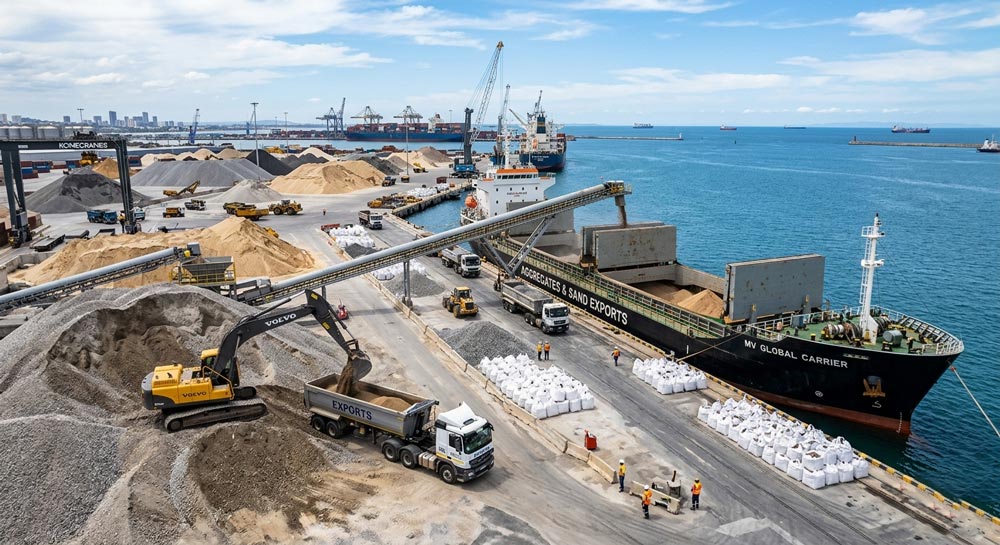
Aggregates are the highest-volume material by weight in any construction programme, and their export economics are dominated by freight cost relative to material value. This means aggregate export is commercially viable primarily for the following scenarios.
Crushed stone (coarse aggregate) — Granite, basalt, and limestone crushed aggregate in 10mm, 20mm, and 40mm sizes are produced across several Indian states, with major quarrying activity in Rajasthan, Karnataka, Andhra Pradesh, and Tamil Nadu. For buyers in island markets or Gulf states where natural aggregate resources are insufficient for large infrastructure programmes, Indian crushed aggregate represents a reliable and quality-consistent supply option.
Manufactured sand (M-Sand) — Produced by controlled crushing of granite or basalt, M-Sand is increasingly preferred over natural river sand due to superior grading consistency, angular particle shape (which improves concrete bond strength), and the growing regulatory restriction on river sand mining in many markets. Indian M-Sand producers can supply to specific grading curves and provide test certificates against IS 383 or equivalent standards.
Natural sand — River sand and pit sand export from India is subject to environmental restrictions and is not available at commercial export volumes from most producing states. Buyers requiring fine aggregate for large-volume programmes should plan around M-Sand or locally sourced alternatives.
Export Restrictions, Duties, and Incentive Schemes for Structural Materials
The export regulatory framework for structural materials from India is more complex than for finished construction products, and buyers should understand it before planning procurement.
Steel India periodically adjusts export duties on steel products in response to domestic supply-demand dynamics and government policy. Export duties on flat steel products and certain long products have been applied and removed at various points in recent years. Before committing to a large steel order, buyers should confirm the prevailing export duty position with their Indian sourcing partner, as duty changes can materially affect landed cost.
Steel exports to several African and Middle Eastern countries benefit from preferential tariff treatment under bilateral trade agreements, and buyers should confirm whether their destination country offers duty concessions on Indian-origin steel under applicable trade frameworks.
Cement There are no specific export restrictions on cement from India, and the sector benefits from established export infrastructure, particularly from coastal plants in Gujarat, Rajasthan, and Andhra Pradesh that are specifically configured for export markets. Cement exports attract basic customs duty drawback benefits that partially offset input costs for exporters.
Aggregates Environmental regulations govern sand mining and aggregate extraction in India, and buyers should work only with suppliers who can demonstrate that their aggregate is sourced from legally operating, environmentally permitted quarries. This is not merely an ethical consideration — illegally sourced aggregate may be seized at origin or create import compliance problems at the destination.
How Ocean Freight Is Priced for Heavy Bulk Materials
The freight economics of structural materials are fundamentally different from those of finished construction products, and understanding them is essential for accurate project cost modelling.
Weight-to-volume ratio. Steel, cement, and aggregates are among the heaviest cargo categories in international trade. A standard 20-foot container (FCL) has a maximum payload of approximately 26–28 metric tonnes. For dense materials like steel and aggregates, cargo weight — not container volume — is the binding constraint. This means the freight cost should always be calculated on a per-tonne basis, not per container, to enable accurate comparison.
Bulk vs containerised shipment. For very large volumes — above approximately 5,000 tonnes — bulk vessel charter becomes an option that can reduce per-tonne freight costs substantially compared to containerised shipment. For project programme managers importing at this scale, bulk charter logistics should be assessed in consultation with a freight forwarder experienced in breakbulk and bulk cargo operations.
Port handling and destination infrastructure. Structural materials require adequate port handling equipment — cranes, forklifts, covered storage for cement — at the destination. Buyers should confirm that their receiving port has the necessary infrastructure before finalising shipment mode. For cement in particular, humidity during transit and at port can compromise product quality, and appropriate moisture protection in packaging and storage is non-negotiable.
Incoterms for structural materials. CIF (Cost, Insurance, Freight) is the most commonly used Incoterms arrangement for structural material exports from India, as it simplifies cost comparison for the buyer and places freight and insurance responsibility with the exporter up to the destination port. For very large orders or established relationships, CFR or FOB may be negotiated depending on the buyer’s preference for controlling freight arrangements.
Combining Structural Materials with Finishing Products in One Order
One of the most practical cost optimisation opportunities available to buyers importing from India is the consolidation of structural and finishing materials into a single shipment where logistics permit.
A construction project at the structural phase typically also has upcoming procurement requirements for tiles, sanitaryware, hardware, electrical fittings, and HVAC systems. Rather than placing separate orders at different times and incurring multiple sets of freight, documentation, and port handling costs, a well-planned consolidated order can supply both structural and finishing materials in coordinated shipments — reducing total logistics cost and simplifying procurement administration.
The key to making this work is having a sourcing partner who can manage multiple product categories simultaneously, coordinate production timelines across different manufacturers, and consolidate goods into optimised container loads. This is precisely the model that Tentex Exports operates — acting as a single point of contact for the full construction material requirement, across both structural and finishing categories, from enquiry through to delivery.
How Tentex Exports Sources Structural Materials from India
Tentex Exports sources steel, cement, and aggregates through established relationships with verified Indian manufacturers and producers across Gujarat, Rajasthan, Andhra Pradesh, and Karnataka. Our structural material procurement process covers grade and specification confirmation, mill test certificate verification, pre-shipment inspection, export documentation, and logistics coordination — the same end-to-end process we apply to all product categories.
For buyers with large or complex structural material requirements — multiple grades, specific dimensional tolerances, combined orders with finishing products — our team works with you to understand the full scope, source optimally across our manufacturer network, and structure the shipment for maximum efficiency.
We also assist buyers in confirming prevailing export duty positions, applicable trade agreement benefits, and destination-country import documentation requirements for structural materials before orders are finalised — ensuring there are no regulatory surprises at the port.
Ready to Source Steel, Cement, or Aggregates from India?
Whether your project requires TMT rebars for a housing development in Nairobi, 53 Grade OPC cement for an infrastructure programme in Accra, or crushed granite aggregate for a commercial development in the Gulf, Tentex Exports has the supplier network, documentation capability, and logistics infrastructure to deliver reliably.
Contact our team to:
- Submit your structural material specification and quantity for a project quote
- Confirm current export duty and trade agreement positions for your destination
- Arrange mill test certificates and quality documentation for your order
- Discuss consolidation of structural and finishing material orders for logistics efficiency
Request a Quote →
Browse Our Building Materials Range →
Tentex Exports is a merchant exporter based in Kerala, India, specialising in construction materials for global markets. We supply steel, cement, tiles, hardware, HVAC systems, electrical products, and building materials to clients across Africa, the Middle East, and Asia.



 CALL ANY TIME
 SAY HELLO





Leave A Comment: