When sourcing hardware and fittings for large-scale construction projects, the country of origin is not just a logistical detail — it is a decision that directly affects product quality, cost efficiency, and delivery reliability. India has steadily built one of the world’s most comprehensive hardware manufacturing ecosystems, and today, architects, procurement managers, and importers across Africa, the Middle East, and Southeast Asia are turning to Indian suppliers as their preferred source for everything from architectural door hardware to industrial-grade fasteners.
This guide offers a detailed, practical overview of India’s hardware and fittings export market — what is available, what standards matter, how pricing compares globally, and what to look for when selecting a sourcing partner.
India’s Hardware & Fittings Manufacturing Landscape
India’s hardware industry is concentrated in several well-established manufacturing clusters that collectively serve both domestic demand and an expanding global export market. The key hubs include:
Aligarh, Uttar Pradesh — Widely regarded as the lock manufacturing capital of India, Aligarh accounts for the majority of the country’s padlock, door lock, and mortise lock production. The city hosts thousands of manufacturers ranging from small ancillary units to large export-oriented factories with modern CNC machining capabilities.
Rajkot and Jamnagar, Gujarat — These cities are dominant in brass components, precision fittings, valves, and fasteners. The brass hardware coming out of Gujarat is exported to over 100 countries and is especially valued for its dimensional accuracy and alloy consistency.
Ludhiana, Punjab — A major hub for stainless steel hardware, including handles, hinges, and architectural fittings. Ludhiana’s hardware manufacturers are well-versed in producing to international specifications and are experienced exporters to the GCC and European markets.
Delhi NCR — Home to a large concentration of hardware distributors, trading houses, and merchant exporters that aggregate products across categories and facilitate efficient international procurement.
This geographic spread means that India can supply the full range of hardware categories — from a basic butt hinge to a high-security multipoint locking system — all within a competitive and well-structured supply chain.
Key Product Types Available for Export
India’s hardware and fittings export catalogue is broad. For construction and infrastructure projects, the most commercially relevant categories include the following.
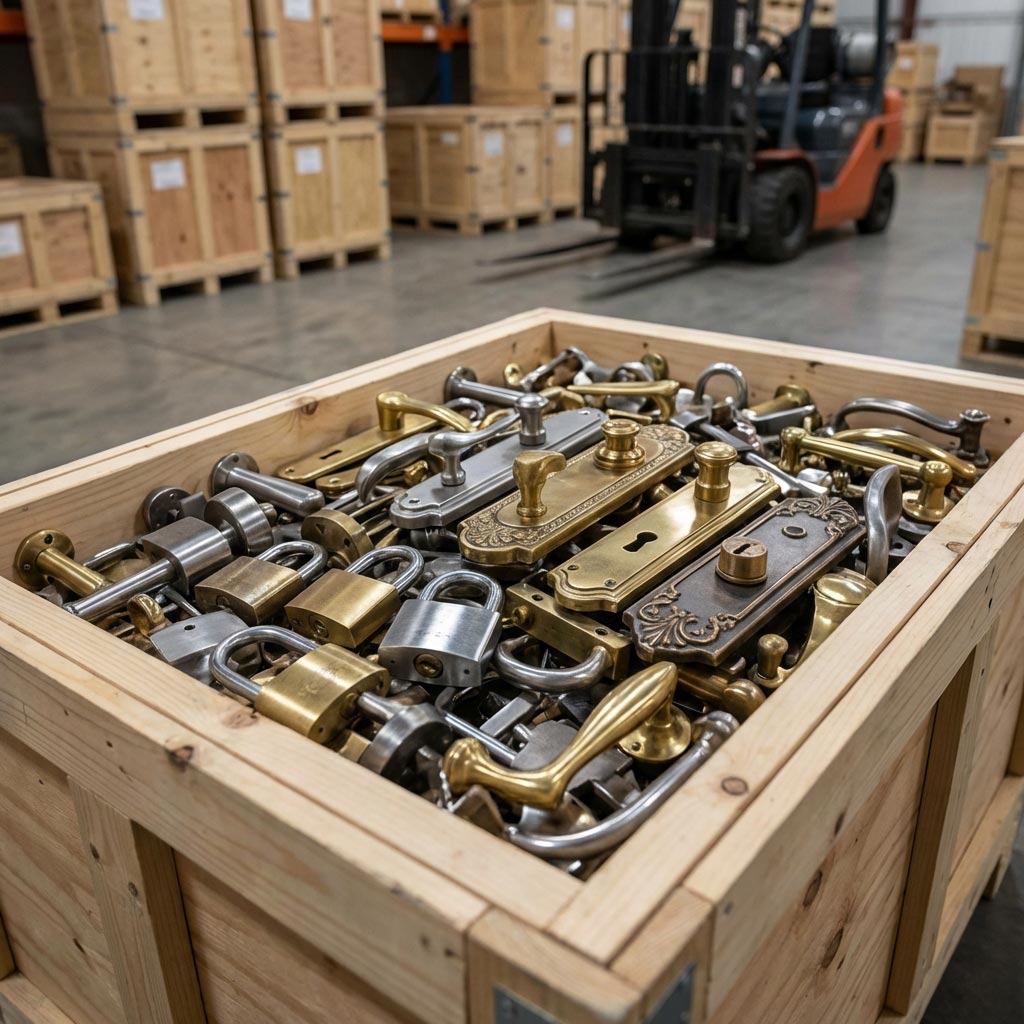
Door Locks and Locking Systems This includes cylindrical locks, mortise locks, deadbolts, padlocks, and digital or smart locks. Indian manufacturers in Aligarh and Delhi NCR produce across all price segments, from economy-grade products for housing projects to premium brass and stainless steel locks for hospitality and commercial developments.
Hinges Butt hinges, concealed hinges, pivot hinges, and heavy-duty weld-on hinges are all manufactured at scale in India. Stainless steel 304 and 316 grades are widely available and appropriate for coastal and humid climates common across the Middle East and East Africa.
Handles and Pull Hardware Lever handles, D-pulls, flush pulls, and architectural door handles in brass, zinc alloy, stainless steel, and aluminium are manufactured to a range of international design standards. Many Indian manufacturers offer custom designs and private labelling for contractors building branded residential or hospitality developments.
Fasteners and Bolts Hexagonal bolts, anchor bolts, machine screws, self-drilling screws, and construction fasteners are produced across Gujarat and Maharashtra. Indian fastener manufacturers comply with ISO, DIN, and ANSI standards, and many hold certifications accepted in GCC, African, and European markets.
Tower Bolts and Barrel Bolts Commonly specified across residential and commercial construction in Africa and the Middle East, these are among the highest-volume hardware items exported from India — available in steel, brass, and stainless steel with varying surface finishes.
Window and Casement Hardware Stays, friction hinges, espagnolette bolts, and window handles for aluminium and UPVC frames are a growing export category as prefabricated window manufacturing expands across East Africa and the Gulf states.
Quality Standards and Certifications to Look For
Not all hardware is equal, and the gap between a low-cost commodity product and a certified, specification-grade fitting can have significant consequences for a construction project — particularly in terms of structural integrity, corrosion resistance, and long-term maintenance.
When evaluating Indian hardware for export, the following standards and certifications are the most relevant benchmarks:
BIS (Bureau of Indian Standards) — The IS mark from BIS is the primary Indian quality certification and is mandatory for a number of hardware categories. It confirms that the product meets minimum safety and performance standards as defined under Indian law.
ISO 9001 certification — A factory-level quality management certification that confirms standardised production processes. This is a baseline requirement for any manufacturer being considered for volume export orders.
AISI / ASTM grades for stainless steel — For stainless steel handles, hinges, and fittings, verify that the manufacturer is using the correct AISI 304 or 316 grade rather than lower-grade alloys. This is particularly important for projects in coastal or high-humidity environments.
DIN and ISO thread standards for fasteners — Fasteners should comply with DIN 931, DIN 933, or ISO 4014 series depending on the specification. Mismatched thread standards are a common and costly sourcing error in international procurement.
CE marking — For projects in Europe or for export buyers who resell into European markets, CE-compliant hardware may be required. A growing number of Indian manufacturers now maintain CE certification for specific product lines.
Any credible Indian hardware exporter should be able to provide material test certificates, dimensional inspection reports, and third-party quality assurance documentation upon request.
Indian Hardware vs European and Chinese Alternatives
The three major sourcing origins for construction hardware globally are India, China, and Europe. Each has a distinct value proposition, and the right choice depends on the specific project requirements, budget, and quality expectations.
India vs China Chinese hardware is widely available and often priced aggressively at the lower end of the market. However, Indian hardware — particularly in brass, stainless steel, and precision-machined categories — is consistently rated higher for dimensional accuracy, alloy quality, and consistency across batches. Indian manufacturers are also generally more responsive to custom specifications and smaller batch sizes, and the growing middle tier of certified Indian factories offers a quality level that is difficult to match from Chinese sources at comparable pricing.
India vs Europe European hardware — particularly German and Italian door hardware — represents the premium end of the market in terms of design, engineering tolerance, and brand value. European products are appropriate for ultra-high-end residential or flagship hospitality projects. However, for mid-to-large construction programmes across Africa and the Middle East, the price differential is rarely justified, and Indian hardware meeting the same functional specifications can deliver equivalent performance at 40–65% lower landed cost.
For most large-scale construction projects in emerging and developing markets, Indian hardware strikes the most effective balance between certified quality, design variety, and competitive export pricing.
Typical MOQs, Lead Times, and Packaging Options
Understanding the commercial parameters of Indian hardware supply is essential for accurate project planning.
Minimum Order Quantities (MOQs) MOQs vary by product and manufacturer. For standard items such as butt hinges, tower bolts, or padlocks, MOQs can be as low as 500–1,000 pieces per SKU. For custom designs, special finishes, or private-label products, most manufacturers require a minimum of 2,000–5,000 pieces to justify tooling and setup costs. For commodity fasteners, MOQs are typically weight-based, starting from 100–500 kg per size.
Lead Times Standard catalogue products are generally available within 15–30 days from order confirmation. Custom or semi-custom products — including bespoke finishes, logo-embossed hardware, or non-standard dimensions — typically require 30–45 days for production. Seasonal demand peaks (October–February) can extend lead times slightly, and orders should be planned with appropriate buffer.
Packaging Hardware for export is typically supplied in inner polybag or foam padding, packed into master cartons for sea freight. Stainless steel and brass products destined for humid climates should be packed with moisture-absorbing silica gel sachets to prevent tarnishing or surface oxidation in transit. Custom retail packaging and blister packs can be arranged for buyers who intend to distribute directly to end consumers.
Shipping Considerations for Metal Hardware
Metal hardware presents specific logistics considerations that buyers and project teams should factor into their sourcing planning.
Weight and FCL economics Metal goods are dense and heavy. A full 20-foot container (FCL) of hardware can carry substantial weight, and the per-unit freight cost decreases significantly once a shipment reaches FCL volume. Buyers with large project requirements should consolidate hardware with other compatible product categories — tiles, electrical components, or construction finishes — to maximise container utilisation and minimise per-unit logistics cost.
Corrosion protection For shipments travelling to coastal destinations or through high-humidity environments — as is common with routes to East Africa and the Gulf — surface protection is critical. Zinc-coated steel products, passivated stainless steel, and lacquered brass are the preferred specifications for hardware travelling by sea over extended transit periods of 15–30 days.
HS codes and import duties Hardware and fittings fall under Chapter 83 of the Harmonised System (HS) tariff schedule. Specific HS codes vary by product type, and import duty rates differ by destination country. Buyers in several African nations can benefit from preferential tariff rates available under trade agreements between India and regional economic blocs. A qualified freight forwarder or customs broker at the destination port should confirm applicable duty rates before final order commitment.
How Tentex Exports Sources and Verifies Hardware Manufacturers
At Tentex Exports, hardware and fittings procurement is handled through a pre-qualified manufacturer network built over years of direct supplier engagement across Aligarh, Gujarat, Punjab, and Delhi NCR.
Our sourcing process for hardware begins with a thorough factory assessment that covers production capacity, quality management systems, export experience, and the ability to meet specific project documentation requirements. We do not list or engage with manufacturers who cannot provide traceability on raw material sourcing or who lack demonstrable compliance with the relevant product certifications.
For every hardware order, Tentex manages the end-to-end process: specification confirmation, sample approval, pre-shipment inspection, export documentation, and logistics coordination. Buyers receive a consolidated shipment with a full documentation package — commercial invoice, packing list, certificate of origin, material test certificates, and bill of lading — prepared to the standards required at their destination port.
For clients whose projects require hardware from multiple sub-categories, Tentex consolidates all items under a single shipment where feasible, simplifying logistics management and reducing total landed cost.
Our capability also extends to custom and private-label hardware for developers and contractors who require project-branded or specification-matched fittings. We coordinate with manufacturers on custom finishes, logo embossing, and tailored packaging as required.
Ready to Source Hardware & Fittings from India?
Whether you are procuring hardware for a 50-unit residential development, a large-scale hospitality project, or a commercial fit-out programme, Tentex Exports has the manufacturer relationships, quality controls, and export infrastructure to deliver reliably.
Contact our team to:
- Request a hardware and fittings product catalogue
- Submit your Bill of Materials (BOM) for a consolidated project quote
- Arrange samples for approval before committing to a bulk order
- Discuss custom specifications, private labelling, or special finish requirements
Request a Quote →
Browse Our Hardware & Fittings Range →
Tentex Exports is a merchant exporter based in Kerala, India, specialising in construction materials for global markets. We supply hardware, tiles, HVAC systems, electrical products, and building materials to clients across Africa, the Middle East, and Asia.



 CALL ANY TIME
 SAY HELLO




Leave A Comment: